
keman
Old Members
-
Joined
-
Last visited
-
It's still the same chord, so maybe that's why it tells you they are consecutive octaves. It looks fine in my humble opinion. :)
-
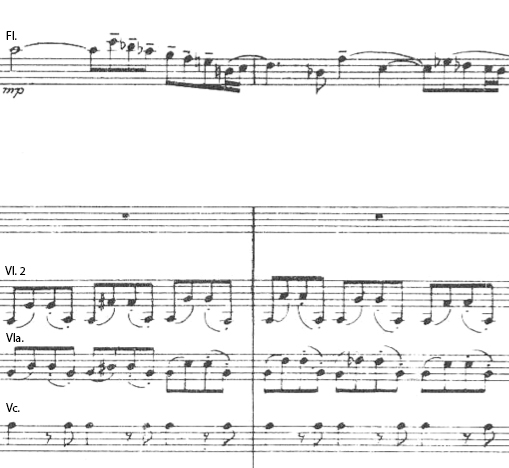
I'm analyzing "Nobilissima Visione" by Paul Hindemith and I'm having some trouble figuring out his intentions. The harmonies played by the strings are clear, but I'm not sure how they are related to the flute melody. The first group is part of the F minor scale, the second one part of the Bb minor scale. But why? Does anyone know more?
-
:censored: :headwall: Just to let off some steam... I was 6th of 102 partecipants... The first 5 received a nomination. :sith: :jedi:
-
I just finished scoring the film for this competition and I'm wondering... did anyone else in this forum participate? The instrumentation is quite interesting (jazz orchestra with classical strings). http://filmmusiccompetition.ch/en/
-
Strictly speaking it is considered a mistake when it's not part of the melody voice. Since a fugue is mainly based on double counterpoint, you shouldn't use them at all. I'm not sure there is a good explanation for this, it's just part of the way people perceived music during the baroque period. But the point is: If that interval is not an essential part of your compositional idea (if it's not part of the melody voice), there's really no good reason to use it either, it will just sound very exposed and probably make your music sound worse than without it.
-
Thanks, this looks great, I'll try to implement it.
-
I don't think it matters if your work isn't as unique as you'd want it to sound like. Composing is not about reinventing the wheel, it's about writing music that pleases you (unless you want to get rich). Plus, there are have been very few composers in the histoy of music that have never "ripped off" other people's work. It's a natural part of the learning process and with time it will help you building up your own repertoire of compository ideas and mould your very own handwriting. From my experience, forcing yourself into writing something unique and different won't work. Composing is, just like the literal meaning of the word says, the process of rearranging existing ideas into a new one.
-
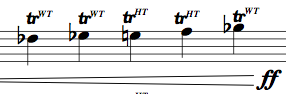
I'm currently working on a violin passage of a piece for jazz orchestra that uses a few consecutive trills. I "came up" with this kind of notation (WT for whole tone and HT for half tone trill): In my opinion this is a lot easier to read than the usual notation with sharps or flat, especially as this part lacks a clear tonal center. The player won't have to "think" about the notes the trills consists of. Still, I don't think I've ever seen this before, so it might be impractical. Your thoughts?
-
I'm scoring a film and I would like to include this effect in my music: Basically the violas and the cellos play "random" harmonic glissandos on the open fourth string ©, while the basses play a tremolo sul ponticello. I'm looking for a way to recreate this effect with my sample libraries. I tried using EQs and filters to isolate certain frequencies of a regular note, but it doesn't sound like harmonics at all. I can't find any libraries or synths that inculde this effect or something similar either. Any suggestions? :)
-
Hey, I mainly compose for films, and until now I've been writing music mainly for orchestra. I would love to start using electronic elements in my compositions, especially for action-driven cues. Something like this: During the first seconds the only real instruments used are the violas on the B. Unfortunately I have no idea how to start... Does anyone have some experience in this field, or know some good synth plug-ins and tutorials that allow me to create this kind of sounds?
-
That's my question. But who plays the tenor voice then?
-
Hey there, I'm currently working on an orchestral piece for a film. The first phrase is played by the string section only (14/12/10/8/6), in a rather low register (see attachment). Due to this fact, the bass voice can be played by the contrabass only, since the sopran voice, its register being too low for the violins, is played by the violas. Now my question: Does it still sound good if the bass is played by the contrabass only? Do you know any pieces where this type of orchestration is used? I am looking for a rather eerie, "evil" sound. (also, the viola and the contrabass are probably going to play divisi to get a more balanced sound). - Keman

-
Uhm, I don't think it's possible to coordinate both at a vibrato speed, is it?
-
Hello there, I am writing a film score for a large orchestra (80 players) and there is a short melodic line that should have the sound of a duduk. However, I am only allowed to use standard orchestral instruments. Since the duduk sound is basically the chalumeau clarinet register with a very wide, vocal vibrato I thought of a very wet, soft clarinet reed. Will a clarinet player do this? Do you know a better solution? - Keman
-